ChatGPT Search vs Google: How AI Search Works
ChatGPT Search generates synthesized, conversational answers with inline citations instead of ranked blue links. Here's what that shift means for SEO and content strategy.
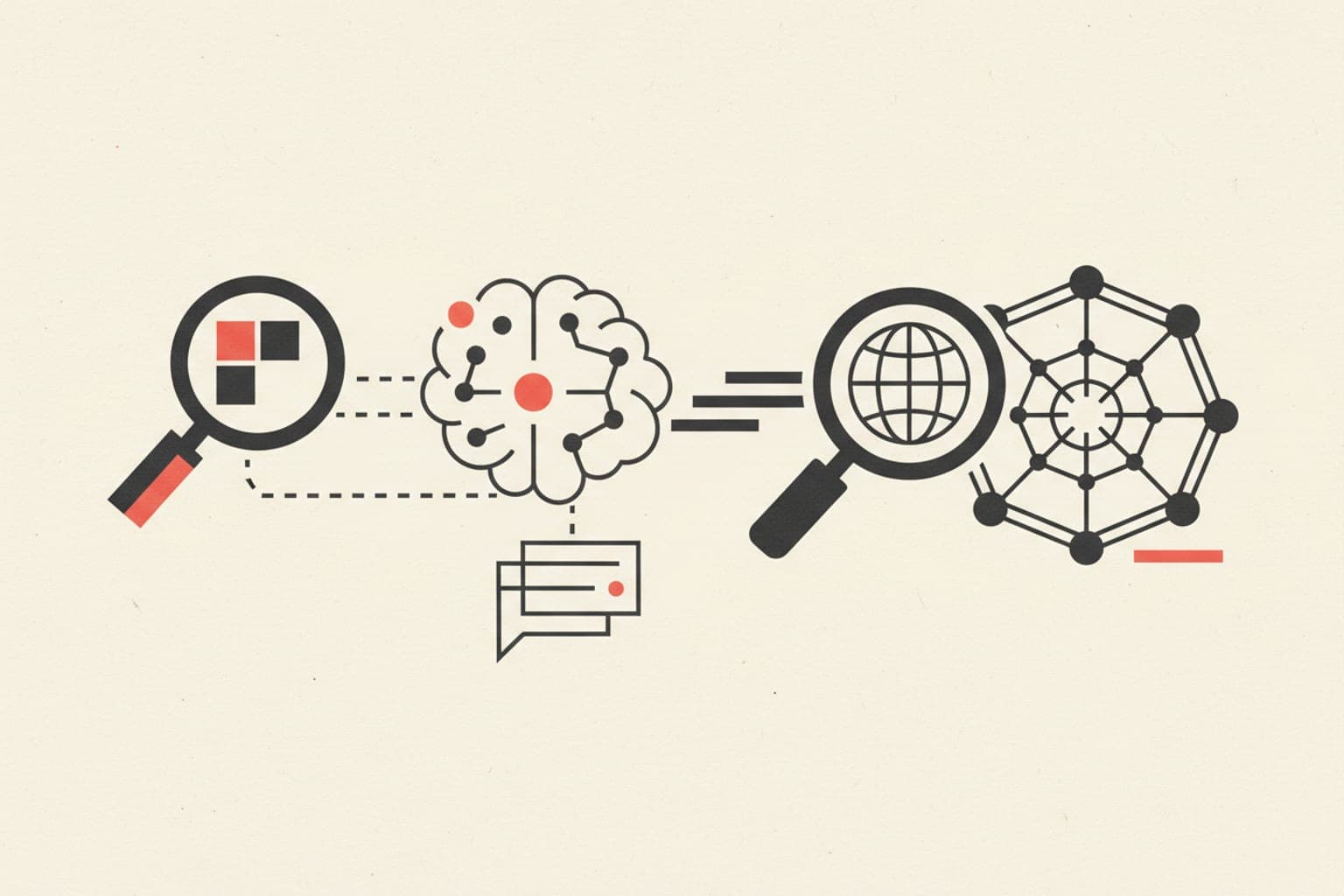
ChatGPT Search is an AI-native retrieval system that fetches live web content and synthesizes it into a single, cited answer — bypassing the traditional ranked list of links that Google returns. Understanding the difference between these two paradigms is now a core competency for any SEO or content practitioner.
What Is ChatGPT Search?#
ChatGPT Search is OpenAI's real-time web retrieval layer built on top of the GPT-4o model. When a user asks a question, the system queries the live web, selects sources it judges to be authoritative and relevant, and composes a direct answer with inline citations. The result is a single synthesized response — not ten blue links.
Key characteristics:
- Conversational output: answers read as prose, not a results page.
- Inline citations: sources are linked within the answer text, not ranked below it.
- Follow-up context: the chat interface retains conversation history, so follow-up questions refine the same thread.
- Live retrieval: unlike the base ChatGPT model, Search pulls current content from the web.
How Does ChatGPT Search Differ From Classic Google?#
Google's core product is a ranked list of URLs scored by hundreds of signals — PageRank, E-E-A-T, Core Web Vitals, backlinks, and so on. The user clicks a link and reads the source. ChatGPT Search, by contrast, reads the sources for the user and composes a summary.
Answer Format
Google returns 10 organic results plus rich features (Featured Snippets, People Also Ask, Knowledge Panels). ChatGPT Search returns one synthesized answer. A site can appear as a citation inside that answer, but visibility is binary — cited or not cited — rather than a ranked position 1 through 10.
Ranking Signals vs. Selection Signals
Google's ranking algorithm weighs explicit signals: backlinks, on-page optimization, Core Web Vitals, structured data. ChatGPT Search's source-selection logic is less transparent, but practitioner observation points to a few consistent factors:
- Topical authority: pages that cover a subject comprehensively and specifically tend to be cited.
- Clear, direct prose: answers that can be extracted as a clean sentence or paragraph are preferred over heavily formatted sales copy.
- Schema markup: structured data helps the model understand entity relationships.
- Crawlability: pages blocked in
robots.txtor behind hard paywalls are not retrievable.
User Intent Handling
Google maps queries to intent categories (informational, navigational, transactional, commercial investigation) and serves different SERP layouts accordingly. ChatGPT Search handles intent conversationally — the model interprets ambiguous queries using prior turns in the chat, and users can rephrase or narrow scope without starting over.
Click-Through Behavior
On a Google SERP, every result is a potential click. On ChatGPT Search, most users receive their answer without clicking. This compresses referral traffic from AI-generated answers versus classic search, which is why citation — having your content mentioned and linked — matters even when direct visits are lower.
What Does This Mean for SEO?#
Classic SEO optimizes for position on a ranked list. AEO (Answer Engine Optimization) optimizes for selection as a cited source inside a synthesized answer. The practical differences are significant:
- Write direct-answer paragraphs. Open each section with a 2-3 sentence answer to the heading question. AI models extract these as citation candidates.
- Use question-based headings. H2 and H3 questions mirror how users phrase queries in conversational interfaces.
- Maintain clean crawlability. Ensure your
robots.txtdoes not inadvertently block GPTBot (OpenAI's crawler). - Invest in topical depth. A single page answering one question well outperforms a shallow hub on 20 topics.
- Implement structured data. FAQ, HowTo, and Article schema help models parse your content's structure.
You can audit whether your site is structurally ready for AI-search citation with SeoChatAI, which checks crawlability, schema, and AEO readiness in a single scan.
How Does ChatGPT Search Retrieve Sources?#
OpenAI's GPTBot crawls the web continuously, and the Search product also integrates with Bing's index for real-time queries. When a user submits a query, the system:
- Reformulates the query into one or more search calls.
- Retrieves candidate pages from the index.
- Reads and ranks extracted passages for relevance and credibility.
- Synthesizes a response using those passages, inserting inline citations.
The model can perform multiple retrieval rounds for complex questions — a behavior OpenAI calls "multi-step reasoning with search."
Does Google Still Matter?#
Absolutely. Google processes vastly more queries per day than ChatGPT Search at this stage, and its advertising ecosystem drives commercial intent traffic at scale. Classic Google SEO remains essential. The strategic shift is that the two systems reward partially different content behaviors, so practitioners need to optimize for both simultaneously rather than treating them as identical channels.
How to Appear in Both Google and ChatGPT Search#
The good news: most best practices overlap.
- Authoritative, well-cited content performs well in both.
- Fast, crawlable, mobile-friendly pages satisfy both Google's Core Web Vitals and AI crawler efficiency.
- Structured data benefits both rich results on Google and entity comprehension by LLMs.
- The key divergence: for ChatGPT Search, prose clarity and direct-answer formatting matter more than keyword density.
Running a dual audit — checking both classic technical SEO and AI-search readiness signals — is the most efficient way to identify gaps. SeoChatAI surfaces both in one report, which makes it a practical starting point before you rebuild content architecture.
Summary#
ChatGPT Search synthesizes answers from live web content; Google ranks a list of links. Both matter in 2024 and beyond. The competitive edge goes to sites that write clearly, structure content semantically, and keep pages crawlable by both Googlebot and GPTBot.
