Google's Helpful Content System: How AI Content Gets Filtered
Google's Helpful Content System is a sitewide classifier that demotes content written primarily for search engines rather than people. Understanding it is essential if you publish AI-assisted content at scale.
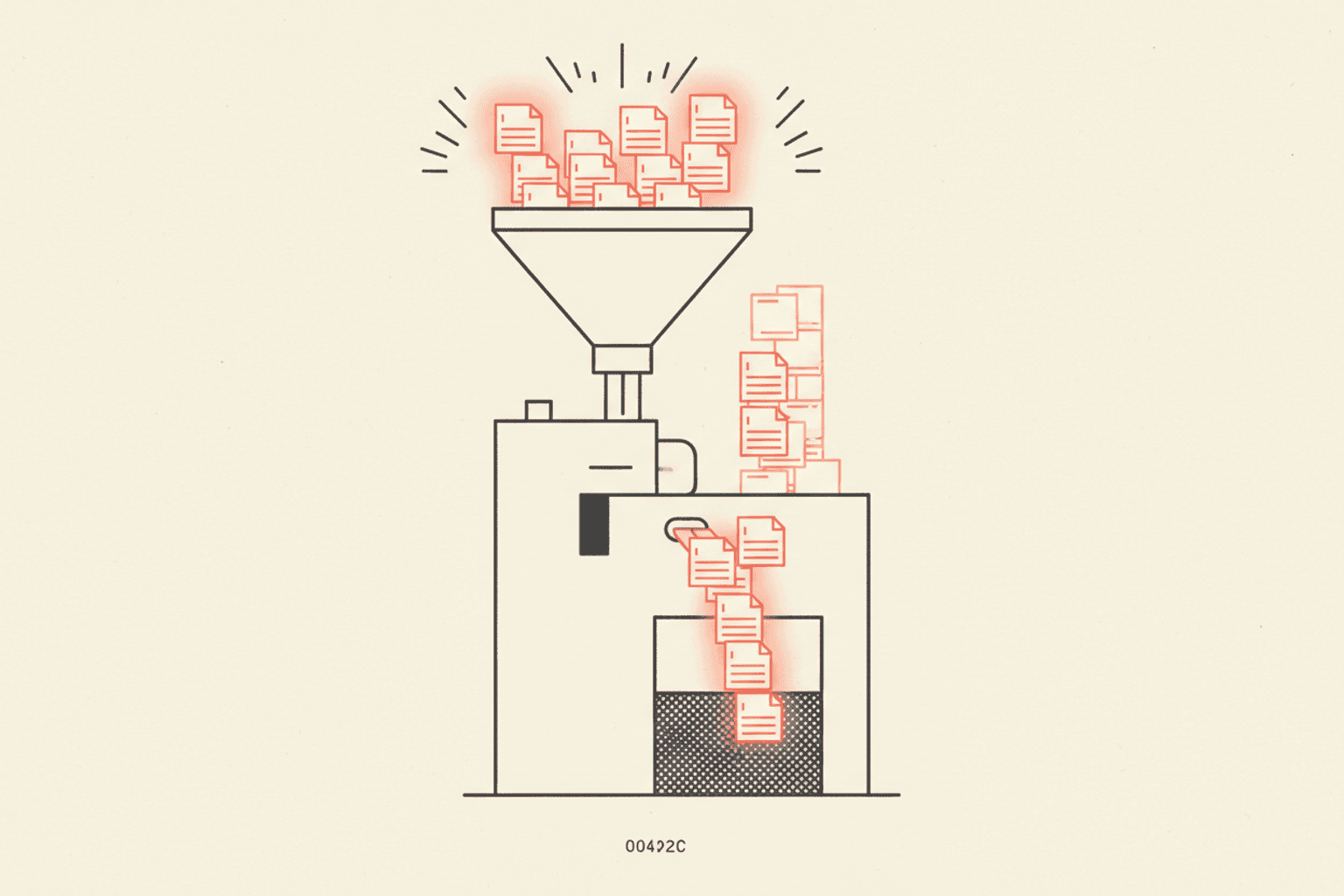
Google's Helpful Content System (HCS) is a sitewide machine-learning classifier that reduces the ranking visibility of content Google determines was created primarily to rank, not to genuinely help a reader. If a meaningful portion of your site's content fails this test, the entire domain can be suppressed — not just individual pages.
What Is Google's Helpful Content System?#
The Helpful Content System is a sitewide signal — one of many Google uses to rank pages — that assesses whether content provides real value to people who land on it from search. It was first rolled out in August 2022, expanded in December 2022, and later folded into Google's core ranking infrastructure in 2024. Unlike a manual penalty, it runs continuously and automatically.
The key word is sitewide. A large volume of low-quality or manipulative content drags down rankings for your best pages too. Google's own documentation describes the target as content that feels "unsatisfying" or leaves users feeling they need to search again to find a real answer.
How Does the Helpful Content System Work?#
HCS uses a classifier — a machine-learning model trained to distinguish people-first content from search-engine-first content. The classifier generates a sitewide signal that feeds into Google's broader ranking systems. It updates continuously rather than on a fixed schedule, so recovery or degradation can happen gradually over weeks.
Google evaluates content against a set of self-assessment questions it has published publicly. These include:
- Does the content demonstrate first-hand expertise or lived experience with the topic?
- Would someone reading it leave feeling they learned something or had their problem solved?
- Is the primary purpose to attract search traffic, or to genuinely inform?
- Does the content make claims it cannot support, or summarize what others have already published without adding anything original?
What Signals Does Google Evaluate?
Google has not published a full technical breakdown of HCS signals, but its guidance and confirmed ranking documentation point to several key factors:
Experience and expertise signals: Content written by someone who has demonstrably done or used the thing being discussed scores better than summaries of summaries. Author bylines, first-person accounts, and cited credentials all contribute.
Content depth vs. breadth: Thin pages that cover dozens of topics superficially are higher risk than focused, in-depth treatments of a narrower subject.
User satisfaction proxies: Google uses engagement signals (pogo-sticking, dwell time, return-to-SERP rates) as downstream quality indicators, though these are correlated rather than directly scored by HCS.
Sitewide content ratio: A site where most content is clearly people-first is less exposed than one where AI-generated or aggregated content dominates the content library.
How Does AI-Generated Content Get Filtered?#
Google's official stance is that AI-generated content is not inherently penalized — what matters is whether the content is helpful, regardless of how it was produced. However, in practice, AI-generated content triggers HCS scrutiny for predictable reasons.
Large language models produce text that:
- Covers topics broadly without original perspective or firsthand experience
- Follows predictable structural templates that are statistically consistent across millions of documents
- Contains confident-sounding claims that may not be verifiable or accurate
- Lacks the specificity that comes from someone who has actually done the thing
These are precisely the patterns HCS was trained to identify. An AI article about "the best hiking boots" written without anyone having tested a single boot is a textbook example of content that looks informative but delivers nothing a reader couldn't have found summarized elsewhere.
What Makes AI Content Survive the Filter?
AI content that passes HCS scrutiny generally has one or more of the following:
- Human editorial layer: A subject-matter expert reviews, augments, and corrects the AI draft, adding original insight
- Original data or experience: The article incorporates proprietary research, test results, or firsthand observations the AI could not have generated
- Narrow focus: The content answers a specific question thoroughly rather than attempting to be a comprehensive guide on a broad topic
- Accurate entity and fact handling: Claims are verifiable and citations are real
Using AI as a drafting assistant rather than a content factory is the operative distinction.
What Happens When a Site Is Hit by HCS?#
Sites that receive a heavy HCS signal see broad ranking drops across many queries simultaneously — a pattern that differs from a standard core update, which tends to move rankings more selectively. Recovery requires improving the overall content quality ratio of the site, not just editing the pages that lost rankings.
Google has stated that simply removing low-quality content can help, but recovery typically takes several months after the classifier re-evaluates the site. There is no manual reconsideration request for HCS — it is automated.
How to Audit Your Site for Helpful Content Compliance#
A structured audit is the fastest way to understand your exposure. Key steps:
- Inventory your content library — identify pages produced primarily by AI without human expert review
- Measure depth and specificity — pages that answer one question thoroughly outperform those that skim ten
- Check author attribution — anonymous or thin author pages raise the risk profile
- Analyze traffic patterns — a broad simultaneous ranking drop across unrelated queries is an HCS fingerprint
- Remove or consolidate thin content — pruning consistently outperforms leaving placeholder content indexed
Tools like SeoChatAI can run a site audit that flags content quality signals and AI-search-engine readiness issues in a single pass, which is useful before and after a suspected HCS impact.
People-First Content: What Google Actually Wants#
Google's guidance consistently returns to one framework: write for people first, and ensure search engines can find and understand it second. Content should demonstrate that the author has genuine knowledge of the subject — ideally through direct experience — and that the reader finishes the page better informed or with their problem solved.
For AI-assisted publishing workflows, this means the human expertise must be present in the content itself, not just in the prompt. An LLM can structure an argument; it cannot replace the practitioner who has run the experiment, used the product, or diagnosed the problem.
Running a regular content audit with SeoChatAI helps you track which pages carry first-hand expertise signals and which are at risk of dragging your entire domain's visibility down.
Key Takeaways#
- HCS is a sitewide, continuous classifier — one poorly performing content cluster affects your whole domain
- AI content is not banned, but it reliably triggers HCS scrutiny when it lacks original experience or expertise
- Recovery from an HCS impact is slow and requires improving the overall content quality ratio, not just patching individual pages
- The fastest protective measure is ensuring every published page has a demonstrable reason to exist beyond capturing a keyword