ChatGPT Citation Share by Industry: Who Wins, Who Lags?
ChatGPT doesn't cite industries equally. Some sectors dominate AI-generated answers while others are nearly invisible. Here's what drives citation share and how any industry can close the gap.
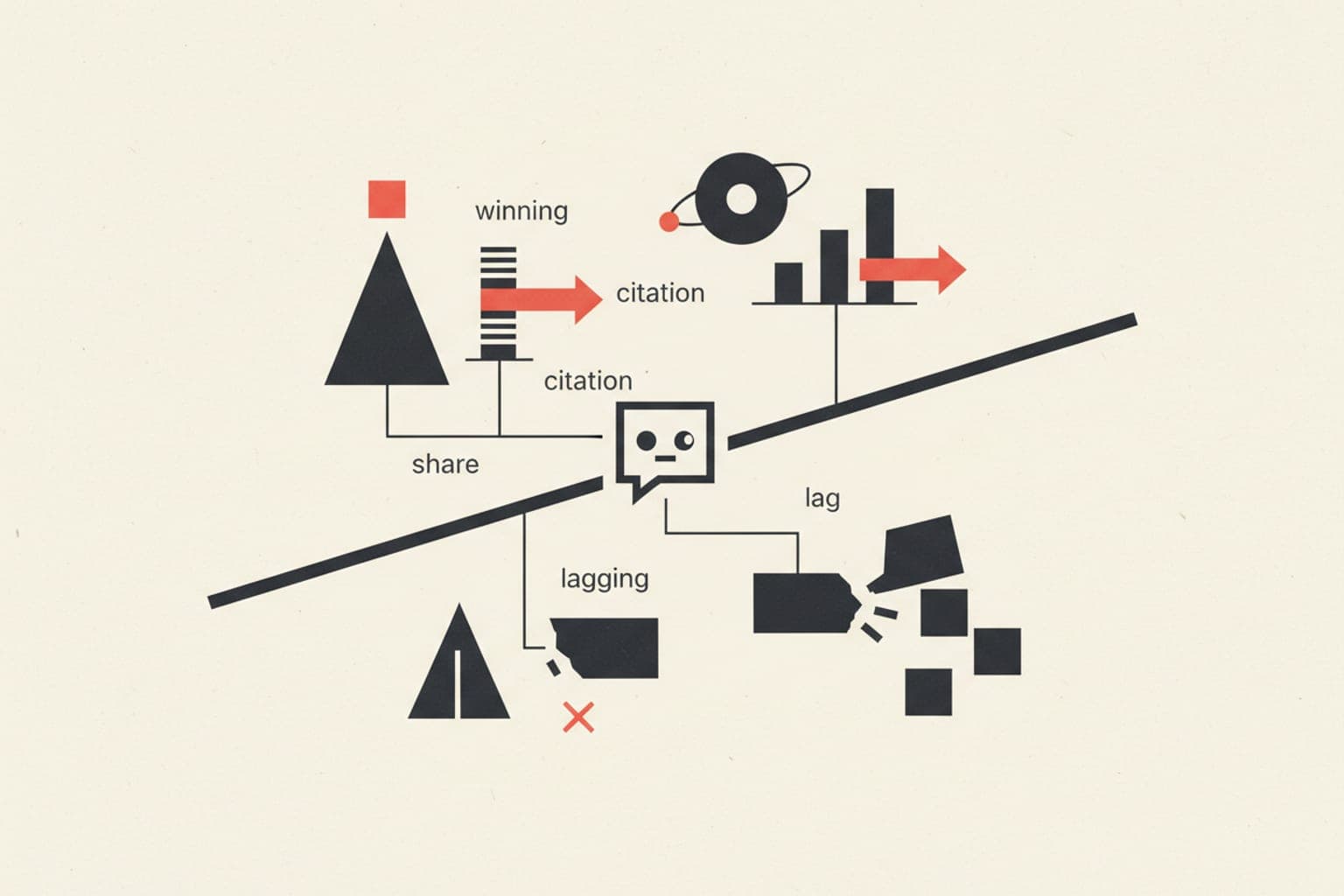
ChatGPT doesn't distribute citations equally across industries. Some sectors appear in AI-generated answers constantly — others barely register. Understanding why that gap exists is the first step to closing it for your brand or vertical.
What Is ChatGPT Citation Share?#
ChatGPT citation share refers to how often content from a given industry, domain, or brand is surfaced — either quoted, paraphrased, or linked — when users ask ChatGPT questions relevant to that sector. It is the AI-search equivalent of organic market share on traditional SERPs.
Unlike Google rankings, citation share is not driven purely by backlinks or domain authority. It depends on how well a source's content matches the structure, clarity, and factual density that large language models favor during retrieval-augmented generation (RAG) and fine-tuning data selection.
Which Industries Tend to Win Citation Share?#
Based on structural observations of how LLMs are trained and how ChatGPT selects sources, certain industries hold a natural citation advantage:
- Technology & Software — High volume of structured, frequently updated documentation, developer guides, and canonical reference content.
- Healthcare & Medical — Peer-reviewed publications, clinical guidelines, and authoritative bodies (WHO, CDC, NHS) dominate factual queries.
- Finance & Legal — Regulatory documents, statute libraries, and licensed news outlets create dense, citable corpora.
- Academic & Research — Preprint servers, journal abstracts, and university repositories are heavily indexed in training data.
- News & Media — High publication frequency and editorial standards make news organizations natural citation candidates.
These sectors share a common trait: they produce structured, authoritative, high-frequency content that training pipelines and RAG retrieval systems can confidently surface.
Which Industries Lag Behind?#
Several sectors are systematically under-cited by ChatGPT, not because their content is low-quality, but because it lacks the structural properties LLMs reward:
- Hospitality & Travel — Heavy reliance on visual content, booking flows, and thin descriptive copy rather than substantive editorial.
- Real Estate — Listing-heavy pages with duplicate descriptions across MLS feeds offer little unique informational value.
- Retail & E-commerce — Product pages optimized for conversion rather than explanation are structurally invisible to LLMs.
- Local Services — Sparse web presence, low publishing cadence, and little original editorial content.
- Entertainment — Subjective content with thin factual scaffolding is harder for LLMs to cite confidently.
The common denominator: transactional intent architecture. These sites are built to convert, not to explain — and LLMs prioritize explanation.
Why Does Citation Share Vary So Much Between Sectors?#
Three structural factors drive the gap:
1. Content Density and Depth
LLMs favor content that answers questions completely within a single passage. Industries that publish long-form explainers, FAQs, how-to guides, and structured reference material naturally match this pattern. Industries that bury information behind paywalls, PDFs, or dynamic JavaScript renders lose citation potential.
2. Schema and Semantic Markup
Healthcare and finance sites frequently use structured data (MedicalCondition, FAQPage, FinancialProduct schemas). This gives crawlers and RAG pipelines semantic anchors. Retail and hospitality sites lean on Product and LocalBusiness schemas that are useful for traditional search but less citation-worthy for conversational AI.
3. E-E-A-T Signal Density
Google's Experience, Expertise, Authoritativeness, and Trustworthiness signals correlate closely with what LLMs trust. Industries with credentialed authors, cited sources, and institutional backing score higher on these signals — and that credibility transfers to AI citation systems.
How Can Lagging Industries Improve ChatGPT Citation Share?#
Catching up is achievable with deliberate content architecture changes:
- Shift from transactional to informational content — Add resource hubs, buying guides, and explainer articles alongside product or listing pages.
- Use structured FAQ and HowTo markup — ChatGPT's browsing and plugin modes, plus future RAG systems, reward explicitly structured answers.
- Publish authoritative long-form content — Aim for pieces that fully answer a query in 600–1,500 words without requiring a click-through.
- Add author credentials and citations — Named experts with verifiable credentials improve E-E-A-T signals that LLMs recognize.
- Increase publication cadence — Freshness signals matter for news-adjacent queries. Industries that rarely publish fall out of retrieval windows.
- Audit your AEO readiness — Tools like SeoChatAI can identify specific gaps in how your site's content is structured for AI search engines, flagging missing schema, thin content, and crawlability barriers that suppress citation share.
What Does a ChatGPT Citation Actually Look Like?#
In ChatGPT's browsing mode or within tools using RAG, a citation appears as a source link attached to a specific claim. In base-model responses without browsing, citation is implicit — the model paraphrases your content without attribution. Both modes depend on the same underlying quality: content that is clear, factual, well-structured, and findable.
For industries competing on AI-search visibility, the goal is to become the source a model wants to cite — not just the page that happens to rank.
How Should You Measure Your Industry's Citation Share?#
Measuring AI citation share is still an emerging discipline, but practical approaches include:
- Prompt sampling — Systematically query ChatGPT with your industry's most common questions and record which sources appear in cited or browsing-enabled responses.
- Brand mention tracking — Monitor whether your brand, product names, or specific data points appear in AI-generated answers across multiple LLM platforms.
- Competitor benchmarking — Compare your citation frequency against known competitors using the same query set.
- Technical content audits — Use platforms like SeoChatAI to audit your content's AI-readiness, identifying structural barriers before they become citation gaps.
The field is moving quickly. Industries that begin measuring now will have a compounding advantage as AI-search share of informational queries continues to grow.
Key Takeaways#
- Technology, healthcare, finance, and academic sectors lead on ChatGPT citation share due to structured, authoritative content.
- Retail, real estate, hospitality, and local services lag because their content is optimized for conversion rather than explanation.
- The gap is structural, not inevitable — lagging industries can close it with targeted content architecture changes.
- Measuring citation share now, while methodologies are still forming, creates a first-mover advantage.
