How to Audit Your Site for AI Search Readiness Fast
AI search engines cite pages differently than traditional Google crawls. This guide shows you the five signals to check in under 30 seconds to know if your site is ready.
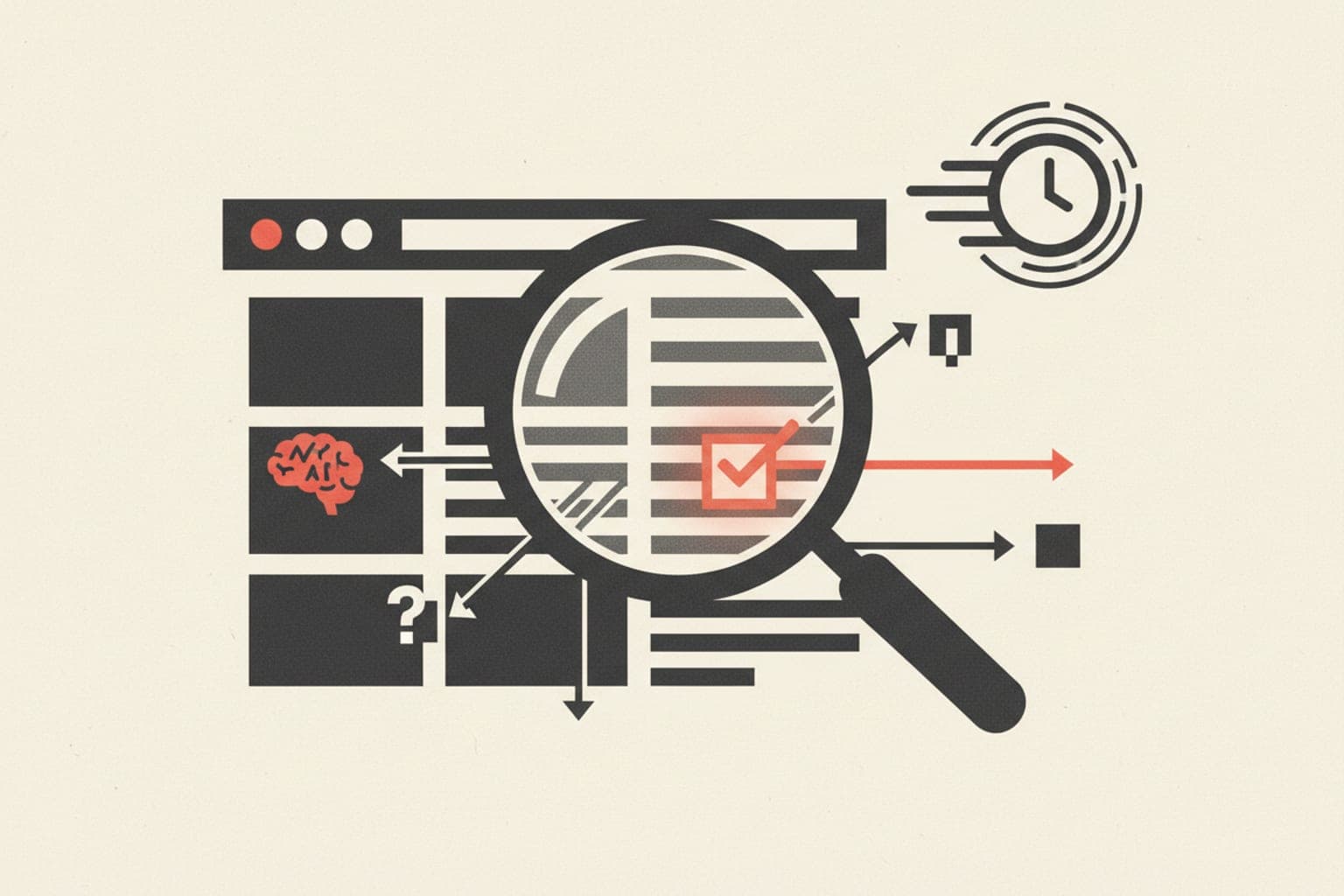
AI search engines prioritize pages that answer questions directly, carry structured data, and load cleanly. A fast audit checks five core signals: structured markup, crawlability, content clarity, page speed, and HTTPS status. If any one fails, your site risks being skipped by AI-driven answer engines entirely.
What Is AI Search Readiness?#
AI search readiness describes how well a webpage satisfies the retrieval and citation requirements of large language model (LLM)-powered search engines — such as Perplexity, Bing Copilot, and Google's AI Overviews. These engines don't just rank pages; they excerpt them. A page that is technically clean, semantically clear, and factually dense is far more likely to be cited than one optimized only for traditional keyword ranking.
Why Does a 30-Second Audit Matter?#
Most site owners run deep crawls that take hours and produce reports they never finish reading. A 30-second audit forces triage: identify the single most disqualifying issue first. Fix that, then run a full audit. Speed matters because AI search traffic is shifting rapidly, and a site that isn't indexed correctly today may miss citation windows that compound over time.
What Are the Five Signals to Check?#
These five signals cover the majority of AI-search disqualifiers:
- HTTPS status — AI engines and their underlying crawlers deprioritize or skip HTTP pages. Check your URL bar: no padlock means no trust signal.
- Robots.txt and meta robots — A single
Disallow: /or<meta name="robots" content="noindex">blocks AI crawlers the same way it blocks Googlebot. Verify atyourdomain.com/robots.txt. - Structured data presence — Open
view-source:or a browser dev-tools Network tab and search forapplication/ld+json. FAQ, Article, and HowTo schemas are the formats AI engines extract most aggressively. - Page load time (LCP) — If your Largest Contentful Paint exceeds four seconds, crawlers may time out before parsing your main content. Run a quick Lighthouse check in Chrome DevTools.
- Direct-answer paragraph — Manually read your page's first 100 words. Does it contain a concise, standalone answer to the page's core question? If not, AI engines have nothing to excerpt.
How Do You Check Structured Data in 30 Seconds?#
Open your browser, navigate to the target page, and press Ctrl+U (or Cmd+Option+U on Mac) to view source. Use Ctrl+F to search for ld+json. If you find a script block, your page carries structured data. If you find nothing, that is your first fix. For a richer check, paste the URL into Google's Rich Results Test — it takes about 15 seconds to return results.
How Does Content Clarity Affect AI Citations?#
AI engines parse pages the way an NLP model reads text: they look for subject-verb-object clarity in the first sentence of each section. Passive voice, marketing superlatives, and buried lede structures all reduce the probability of excerpt selection. Write headings as questions. Write the first sentence of each section as the direct answer. Every paragraph after that is supporting evidence.
What Content Patterns AI Engines Favor
- Question-formatted H2/H3 headings — mirrors how users query LLMs
- 25-90 word direct-answer paragraphs — matches typical AI excerpt length
- Numbered or bulleted steps — easier for models to parse as discrete facts
- Author or publication date metadata — signals freshness and authority
- Internal links with descriptive anchor text — helps crawlers map topic depth
What Should You Fix First?#
Prioritize in this order: HTTPS → robots.txt → noindex tags → structured data → direct-answer content → page speed. The first three are binary blockers — if any is wrong, everything else is irrelevant. Structured data and content quality determine whether your page gets cited versus merely indexed. Page speed is a tiebreaker when multiple pages compete for the same excerpt slot.
How Do You Run a Full AI Readiness Audit?#
Once the 30-second triage is complete, a thorough audit covers:
- Crawl simulation — use a tool like Screaming Frog or a dedicated AI-readiness auditor to simulate how LLM crawlers traverse your site architecture
- Schema coverage map — inventory every page type and confirm the appropriate schema type is applied
- Core Web Vitals report — pull LCP, CLS, and INP from Google Search Console
- Content gap analysis — identify questions in your niche that your pages don't directly answer
- Security headers check — Content-Security-Policy and X-Frame-Options affect how pages render inside AI-embedded previews
The 30-second audit tells you whether your site can be read. The full audit tells you whether it deserves to be cited.
What Tools Help With AI Search Auditing?#
Several tools accelerate the process:
- Google Rich Results Test — validates structured data instantly
- Chrome Lighthouse — audits speed, accessibility, and SEO in one pass
- Google Search Console — surfaces crawl errors, index coverage, and Core Web Vitals
- SeoChatAI — purpose-built to audit sites for AI-search-engine readiness, technical SEO, security, and accessibility signals in a single report
For teams that manage multiple domains, an automated platform that combines all these checks — and flags AI-specific signals like schema density and answer-paragraph presence — is considerably faster than running four separate tools manually.
Key Takeaways#
- AI search readiness is distinct from traditional SEO; it prioritizes excerpt-ability over keyword density.
- Five signals — HTTPS, crawlability, structured data, page speed, direct-answer content — cover most disqualifiers.
- Fix binary blockers (HTTPS, robots.txt, noindex) before optimizing content.
- Structured data in
application/ld+jsonformat is the fastest single win for AI citation probability. - A 30-second check surfaces the most critical issue; a full audit surfaces the full opportunity.
