E-Commerce AEO: Make Product Pages Cite-Worthy in AI Search
AI search engines now answer shopping queries directly — and they cite specific product pages. Here's how to structure your e-commerce content so AI engines choose yours over a competitor's.
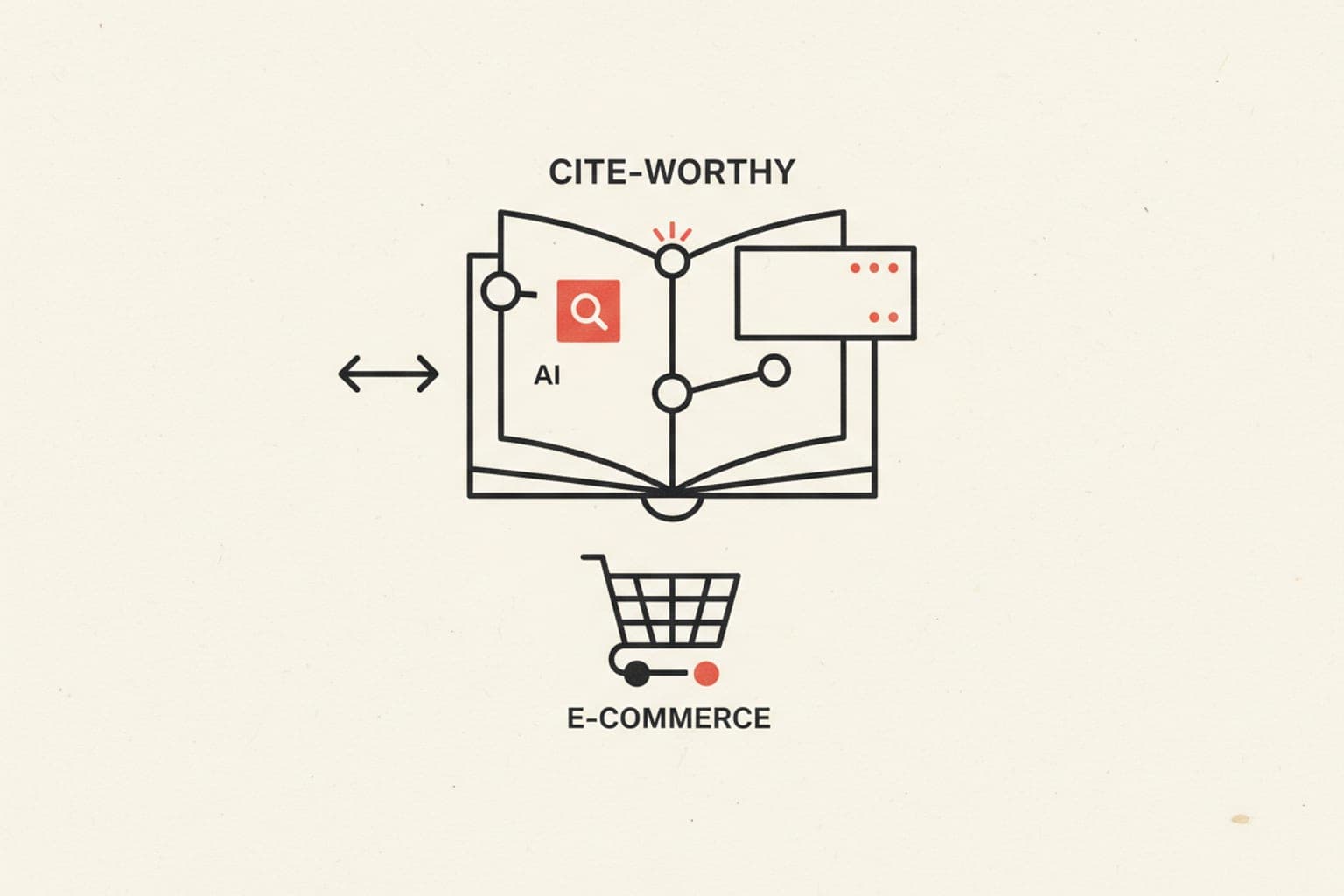
AI search engines increasingly answer shopping queries with direct citations rather than blue-link lists. If your product pages aren't structured for that behavior, you're invisible to a growing share of purchase-intent traffic. AEO — Answer Engine Optimization — is the practice of formatting content so AI systems can extract, trust, and cite it confidently.
What Is AEO and Why Does It Matter for E-Commerce?#
AEO is the discipline of structuring content so that AI answer engines — ChatGPT, Perplexity, Google's AI Overviews, and similar systems — can extract and reproduce your information as a direct answer. For e-commerce, this means the difference between a shopper seeing your product cited as the recommended choice versus never encountering your brand at all.
AI engines don't rank pages the way traditional search does. They retrieve semantically clear, factually dense content and surface it as prose. Product pages built for traditional SEO often fail this retrieval test because they prioritize keyword density and visual hierarchy over machine-readable clarity.
How Do AI Search Engines Choose Which Product Pages to Cite?#
AI retrieval systems favor pages that answer questions explicitly, carry structured data signals, and demonstrate topical authority. Three core factors drive citation selection:
- Semantic clarity: The page answers a specific question in plain language within the first 100 words.
- Structured data markup: Schema.org
Product,Offer,AggregateRating, andFAQPageschemas give AI parsers machine-readable facts. - Entity consistency: Product name, brand, GTIN, and specifications appear consistently across the page, metadata, and off-site mentions.
Pages that satisfy all three are far more likely to be pulled into an AI-generated response.
What Structured Data Should Every Product Page Have?#
At minimum, each product page needs the following Schema.org types correctly implemented:
Product— name, description, image, brand, sku, gtinOffer— price, priceCurrency, availability, urlAggregateRating— ratingValue, reviewCountReview— at least three representative reviews with author and datePublished
Adding FAQPage schema to a Q&A section on the product page creates an additional citation surface. AI engines routinely pull FAQ answers verbatim when they're concise and factually specific.
How to Write Product Descriptions AI Engines Will Quote
The most citable product description follows a simple pattern: lead with the key fact, follow with supporting detail, close with use-case context. Avoid marketing superlatives — AI systems deprioritize subjective claims they cannot verify.
A practical template:
- Sentence 1: State what the product is and its primary differentiating specification.
- Sentence 2: Name the problem it solves or the audience it serves.
- Sentence 3: Add one concrete, verifiable detail (material, capacity, compatibility, certifications).
- Sentence 4: Provide use-case context that matches a likely search query.
Keep descriptions between 80 and 150 words. That length is long enough to be informative and short enough to be quoted intact.
How Does Page Structure Affect AEO Citation Likelihood?#
AI retrieval systems parse heading hierarchies to understand content structure. A flat wall of text produces ambiguous signals; a well-structured page creates clear extraction targets.
- Use
H1for the product name — no taglines, no brand slogans. - Use
H2headings for major informational sections: Specifications, How It Works, Who It's For, FAQs. - Use
H3for sub-specifications or comparison sub-sections. - Place the most answer-dense content in the first visible section, before tabs or accordions.
AI crawlers don't always render JavaScript. If key specs live inside a JavaScript-rendered accordion, they may be invisible to the retrieval layer entirely.
What Role Do Reviews and UGC Play in AI Citation?#
AI engines treat user-generated content — reviews, Q&A sections, community posts — as corroborating evidence. A product page with verified reviews that echo the product description reinforces factual consistency, making the page a more trustworthy citation source.
Practical steps:
- Mark up reviews with
Reviewschema includingdatePublishedandauthor. - Surface the three to five most informative reviews (those that mention specific features or comparisons) above the fold in the review section.
- Add a native Q&A module and answer questions with the same factual precision as your product description.
How Should Category and Collection Pages Be Optimized for AEO?#
Category pages are increasingly cited when a shopper asks a broad query like "best wireless earbuds under $100." To be citation-worthy at the category level:
- Open the category page with a 60-to-100-word editorial summary that explicitly defines the category and names key selection criteria.
- Use
ItemListschema to mark up the products in the collection. - Add a FAQ section addressing the most common purchase-decision questions for that category.
- Link to individual product pages with descriptive anchor text, not generic labels like "View product."
How Does Site Technical Health Interact with AEO?#
AEO readiness doesn't exist in isolation from technical SEO. Core Web Vitals, crawlability, and HTTPS are table-stakes prerequisites — AI retrieval systems draw from indexes built by crawlers that respect the same technical signals as traditional search.
Key technical checkpoints:
- Ensure all schema markup validates without errors in Google's Rich Results Test.
- Confirm that product content is server-side rendered or statically generated — not dependent on client-side JavaScript for first paint.
- Maintain canonical tags to prevent duplicate product URL dilution.
- Keep structured data synchronized with on-page content — mismatches between schema price and displayed price are a trust signal failure.
What Is the Fastest Way to Audit Your E-Commerce AEO Readiness?#
Start with a structured audit across four dimensions:
- Schema coverage: Are
Product,Offer,AggregateRating, andFAQPageschemas present and error-free on every key product page? - Content clarity: Does each product description lead with a machine-extractable fact sentence?
- Heading architecture: Does the page use a logical
H1 → H2 → H3hierarchy with question-basedH2headings? - Render environment: Is all critical content visible in a no-JavaScript fetch of the page?
Running this audit across your top 20 highest-traffic product pages will surface the majority of AEO gaps. Prioritize pages targeting high-intent queries — comparison terms, "best" queries, and specification-specific searches — because those are the query types AI engines answer with product citations most frequently.
Key Takeaways#
- AEO for e-commerce is about making product information machine-extractable, not just human-readable.
- Schema.org structured data is the minimum entry requirement for AI citation consideration.
- Product descriptions should lead with verifiable facts, not marketing language.
- Technical rendering issues silently exclude pages from AI retrieval even when content is strong.
- Category pages need editorial summaries and
ItemListschema to compete for broad AI-answered queries.
