Claude vs ChatGPT for Citations: When Each Engine Wins
Claude and ChatGPT cite sources in fundamentally different ways. Knowing which engine favors your content type—and why—lets you write pages that get pulled into AI-generated answers.
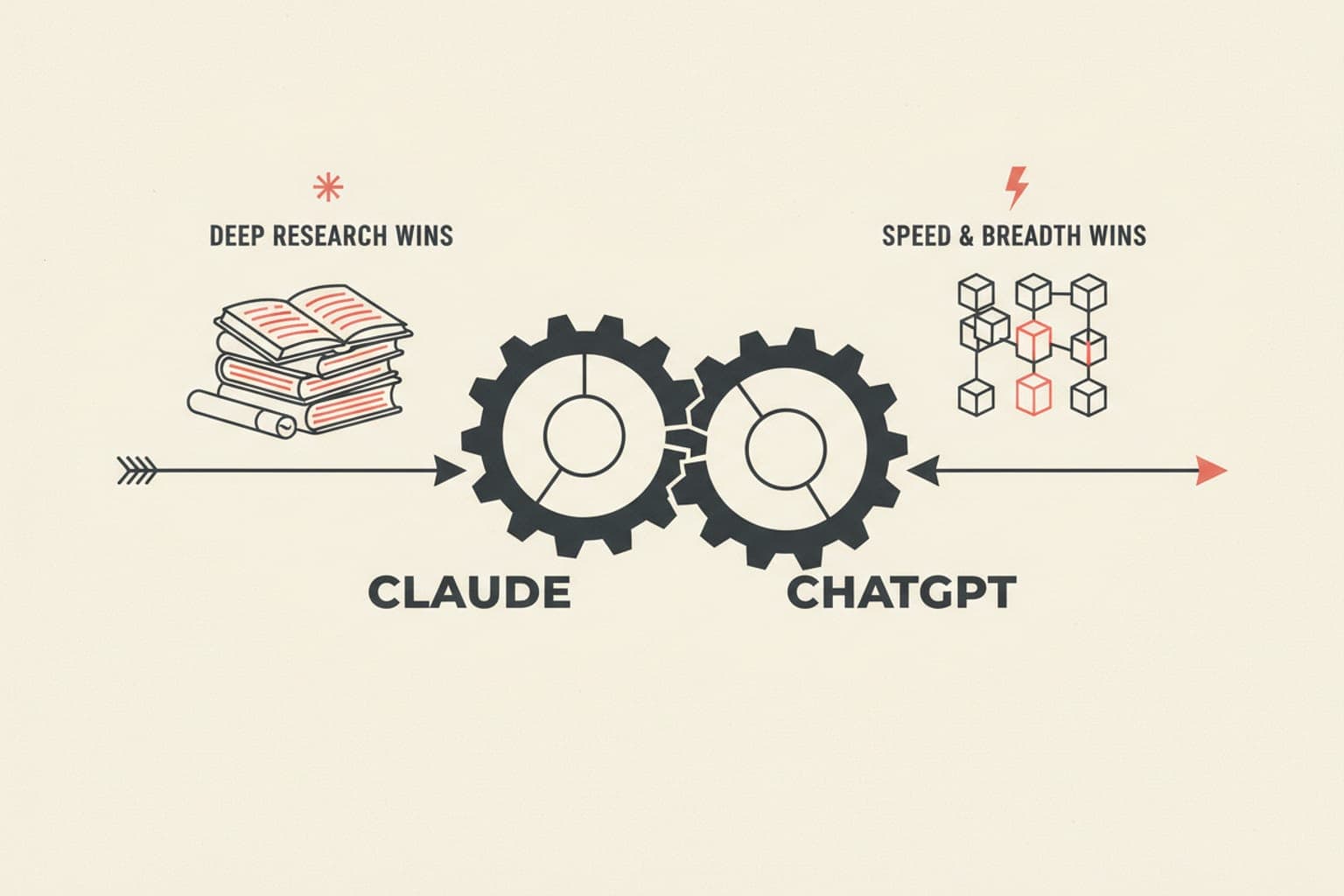
Claude and ChatGPT are both answer engines, but they cite sources differently, favor different content structures, and reward different optimization strategies. If you want your pages pulled into AI-generated answers, you need to know which engine you're writing for—and when each one wins.
What Is the Core Difference Between Claude and ChatGPT for Citations?#
Claude (Anthropic) prioritizes cautious, hedged attribution—it often paraphrases and credits the source structure of an argument rather than lifting verbatim quotes. ChatGPT (OpenAI, especially with Browse or Retrieval) tends to pull exact passages and link them directly, making keyword-dense, scannable content easier to surface. In short: Claude rewards reasoning depth; ChatGPT rewards surface clarity.
How Does Claude Decide What to Cite?#
Claude's citation behavior is shaped by its Constitutional AI training, which emphasizes epistemic honesty. It tends to:
- Favor pages that explain why something is true, not just what is true
- Credit sources with clear logical structure (if-then reasoning, numbered conclusions)
- Surface content that matches the user's question with minimal inferential leap
- Prefer longer, denser explanations where nuance is visible
If your page buries the direct answer inside several paragraphs of context, Claude is more likely to find and attribute it than ChatGPT—because it reads more of the page.
How Does ChatGPT Decide What to Cite?#
ChatGPT with web retrieval (via Bing or its own Browse tool) functions more like a traditional retrieval-augmented generation (RAG) pipeline. It:
- Scores passages using semantic similarity to the user query
- Pulls short, high-density answer blocks—often the first direct-answer paragraph on a page
- Links cited URLs inline, rewarding pages that load fast and parse cleanly
- Responds well to FAQ-style content with question headings that mirror user queries
This makes ChatGPT more predictable to optimize for: front-load your answer, match the query vocabulary, and use clean HTML structure.
When Does Claude Win the Citation Battle?#
Claude is the stronger citation vehicle in these scenarios:
- Complex, multi-step topics — medical, legal, technical, or policy subjects where the reasoning chain matters
- Long-form authoritative content — whitepapers, academic summaries, in-depth guides
- Comparative or nuanced arguments — Claude reads the full arc of an argument, not just the first paragraph
- Hedged or qualified claims — Claude surfaces "it depends" content more naturally than ChatGPT, which prefers declarative statements
If your content lives in a domain with real complexity, optimizing for Claude's reading depth is the higher-leverage play.
When Does ChatGPT Win the Citation Battle?#
ChatGPT has the citation edge in:
- High-volume informational queries — "what is," "how to," "best X for Y" formats
- FAQ and list-driven content — short, scannable answer blocks with H2 question headings
- Freshness-sensitive topics — ChatGPT Browse favors recently indexed pages; Claude's training cutoff limits real-time retrieval
- E-commerce and product research — ChatGPT is more often used for transactional research where a direct recommendation closes the loop
For content teams running high-frequency, query-matched publishing, ChatGPT citation optimization delivers faster measurable lift.
What Content Structure Gets Cited by Both Engines?#
Some structural elements perform well across both Claude and ChatGPT:
- Direct-answer paragraph in the first 50 words — both engines extract this block
- H2/H3 headings phrased as questions — mirrors how users query both interfaces
- Short paragraphs (3-4 sentences max) — easier for RAG chunking and Claude's summarization
- Explicit conclusions or summaries — Claude reads them; ChatGPT retrieves them as closing snippets
- Stable, crawlable URLs with clean markup — both engines penalize JavaScript-heavy, slow-loading pages
Running a technical audit to confirm your pages are crawlable by AI agents is a logical first step. Tools like SeoChatAI can surface structural and accessibility issues that silently block AI citation.
How Should You Optimize Differently for Each Engine?#
For Claude
- Write longer paragraphs that show reasoning, not just conclusions
- Use connective language: "because," "therefore," "this means that"
- Avoid over-relying on bullet lists; prose logic is what Claude extracts
- Include authoritative qualifications (author credentials, methodology notes)
For ChatGPT
- Front-load the exact answer to the query in sentence one
- Use the user's exact phrasing in your H2 headings
- Structure content in FAQ blocks with one question, one tight answer
- Ensure your page is indexed, fast, and returns a clean 200 status
Does Page Authority Still Matter for AI Citations?#
Yes, but differently than for traditional SERP rankings. Neither Claude nor ChatGPT citations are pure popularity contests. Claude is more likely to surface a well-reasoned page from an unknown domain than Google would. ChatGPT Browse still applies some domain authority signals inherited from Bing's index—so established domains have a mild advantage in high-competition queries. But for niche, specific questions, answer quality frequently outweighs authority.
How Do You Track Whether You're Being Cited?#
AI citation tracking is still an emerging practice. Current approaches include:
- Manually querying Claude and ChatGPT with your target questions and checking for attribution
- Monitoring branded query spikes in Google Search Console as a proxy for AI-driven traffic
- Using structured prompt testing across model versions to track citation frequency
- Checking for referral traffic from Bing (which feeds ChatGPT Browse) as a signal of retrieval visibility
Platforms built for AEO auditing—like SeoChatAI—are beginning to incorporate AI citation visibility into their reporting layer, which will become a standard diagnostic as AI search matures.
What Is the Practical Takeaway for Content Teams?#
Don't pick one engine to optimize for—build content that earns citations from both. The overlap is substantial: direct answers, question-headed sections, clean markup, and genuine explanatory depth. Where they diverge, let your content type guide you. Complex, reasoned content earns Claude citations. Query-matched, scannable content earns ChatGPT citations. The best pages do both.
