Which Website Categories Block AI Bots Most in 2026?
Not all websites treat AI crawlers equally. Across our 2026 audit corpus, certain industries block AI bots at dramatically higher rates than others — with real consequences for brand visibility in AI-generated answers.
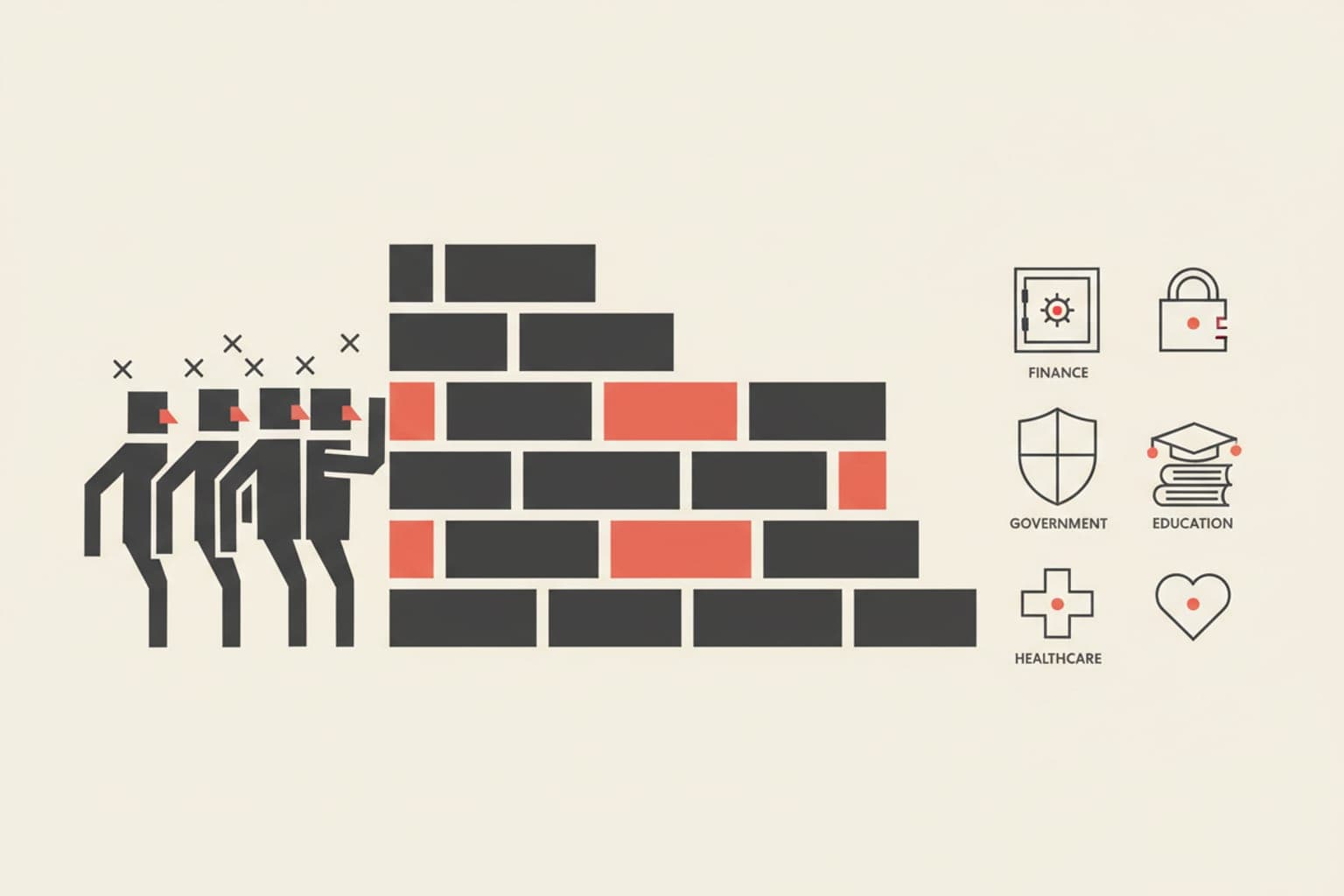
AI crawler blocking is no longer a fringe decision made by a handful of privacy-conscious publishers. Across the web, site owners are actively deploying robots.txt directives, HTTP headers, and WAF rules to deny access to bots like GPTBot, ClaudeBot, and Google-Extended. The distribution is far from uniform: industry vertical is one of the strongest predictors of whether a site opts out.
What Does "Blocking AI Bots" Mean?#
Blocking AI bots means explicitly instructing AI training and retrieval crawlers not to access a site's content. The most common mechanism is a robots.txt disallow rule targeting specific user-agent strings such as GPTBot (OpenAI), ClaudeBot (Anthropic), Google-Extended (Google's AI training crawler), and PerplexityBot. Blocks can also be enforced at the CDN or WAF layer, making them invisible to standard crawl audits.
A site that blocks these crawlers opts out of two distinct pipelines:
- AI training data — content won't be used to train future model versions.
- Retrieval-augmented generation (RAG) — content may be excluded from real-time AI answer generation, reducing citation likelihood.
Which Categories Block AI Bots Most Aggressively?#
Based on qualitative patterns emerging from publisher behavior, legal developments, and opt-out advocacy in 2025–2026, several categories stand out as the most aggressive blockers.
News and Journalism
News publishers were among the first to mobilize against AI crawlers, and they remain the most organized. The combination of copyright sensitivity, existing licensing infrastructure (wire services, syndication deals), and ongoing litigation created strong institutional incentives to block. Major news organizations have publicly documented their robots.txt changes, and the pattern has cascaded to regional and independent outlets.
Key drivers:
- Fear of content substitution (AI summaries replacing click-throughs)
- Existing paywalls that crawlers could circumvent
- Active industry coalitions pushing for AI licensing frameworks
Publishing, Books, and Long-Form Media
Book publishers and literary magazines face the same copyright concerns as news, amplified by high-profile class-action lawsuits involving author guilds. Blocking is common among sites affiliated with traditional publishing houses, author portfolios, and writing communities. The creative-rights angle is emotionally resonant and drives opt-out even when the legal outcome is uncertain.
Legal and Professional Services
Law firms, legal databases, and professional licensing bodies block AI crawlers at elevated rates. Their reasoning differs from publishers: the concern is liability, not copyright. If an AI model cites a lawyer's analysis incorrectly or out of context, it could constitute unauthorized legal advice or damage professional reputation. Compliance-driven IT departments also tend toward conservative defaults.
Financial Services and Fintech
Regulated financial content — market analysis, investment commentary, credit guidance — carries compliance risk. Financial institutions block AI crawlers to avoid their regulated disclosures being stripped of context, or to protect proprietary research. Firms with institutional clients are particularly cautious, since AI misattribution of financial guidance can create regulatory exposure.
Healthcare and Medical
Medical publishers, hospital systems, and clinical resource providers are acutely aware of the stakes when AI models hallucinate or misrepresent health information. Blocking AI crawlers is partly a patient-safety argument and partly liability mitigation. HIPAA-adjacent concerns, even where technically inapplicable, create a culture of caution.
Academic and Research Institutions
The academic sector is split. Open-access repositories often welcome crawling; subscription-based databases and preprint servers with publisher partnerships frequently do not. The debate mirrors the news industry: does AI access expand reach, or does it substitute for subscriptions? Institutions with licensing deals (similar to those signed with Microsoft or OpenAI) may selectively allow specific bots while blocking others.
Entertainment and Sports Media
Premium entertainment content — sports statistics, film criticism, music journalism — sits at the intersection of copyright and traffic dependency. These publishers rely heavily on search-driven discovery and worry that AI-generated sports recaps or review summaries eliminate the need to visit the source. Blocking rates here are rising, though from a lower baseline than news.
Which Categories Block AI Bots Least?#
Some verticals are net beneficiaries of AI visibility and actively avoid blocking.
- SaaS and B2B software — Being cited in AI answers is free brand exposure and drives qualified traffic. Most block rates are low.
- Local services (plumbing, HVAC, dentistry) — These sites often lack the technical sophistication to implement targeted bot blocks; default permissiveness is common.
- E-commerce (mid-market) — Product data in AI answers can drive purchase intent. Sophisticated retailers are cautious about letting competitors' AI tools scrape pricing, but outright GPTBot blocks are less prevalent than in media.
- Government and public institutions — Legally mandated openness, transparency obligations, and a mandate to inform citizens create strong incentives to remain crawlable.
How Does Category Block Rate Affect AI Search Visibility?#
If an entire industry blocks AI crawlers, AI models are trained and prompted on a thinner slice of that domain's knowledge. The practical consequences:
- Citation gaps — AI answers about heavily blocked categories cite fewer primary sources and over-rely on the minority that remain open.
- Competitor advantage — Within a blocked category, the site that opts in gains disproportionate citation share.
- Hallucination risk — Sparse training data in a vertical correlates with lower answer accuracy, which can ultimately harm the entire category's reputation in AI-mediated search.
How Can You Audit Your Own AI Bot Posture?#
Understanding whether your site is visible to AI crawlers requires a structured audit. You can use SeoChatAI's website audit tool to check your robots.txt configuration, identify which AI user-agents are blocked or allowed, and benchmark your posture against category norms. The audit surfaces both deliberate blocks and accidental exclusions — a common problem when legacy robots.txt wildcard rules inadvertently catch modern bot user-agents.
Steps to assess your posture:
- Fetch and parse your
robots.txtfor known AI bot user-agents. - Check for CDN-level or WAF-level blocks that bypass
robots.txt. - Review HTTP response codes served to bot user-agents (403, 429, and 503 are common block signals).
- Compare your allow/deny list against the current canonical list of AI crawlers.
- Decide intentionally: blocking or allowing should be a documented business decision, not an accident.
Should You Block AI Bots or Stay Open?#
The answer depends on your business model and risk profile. There is no universally correct posture.
Block if:
- Your revenue depends on keeping users on-site (paywalled content, subscription media).
- You face copyright or compliance risk from misattribution.
- You have ongoing or anticipated litigation related to AI training data.
Stay open if:
- AI citation is a brand-building or lead-generation channel.
- You want to compete for visibility in AI-generated answers.
- Your content is informational, non-proprietary, and benefits from wide distribution.
The nuanced middle path — selective blocking by user-agent — is increasingly viable. You can block GPTBot (training) while permitting PerplexityBot (real-time retrieval), maintaining influence on AI answers without contributing to training corpora you object to.
What Should Site Owners Do Right Now?#
Regardless of your category or blocking decision, the most important action is intentionality. Run a full AI readiness audit with SeoChatAI to know exactly what your current robots.txt and server configuration communicate to AI crawlers. An accidental block costs you citation share; an accidental open door may expose you to risks you haven't assessed. In 2026, leaving this to chance is not a neutral decision.
