What Is Perplexity AI? Search vs Answer Engines Explained
Perplexity AI is an answer engine, not a traditional search engine. Instead of returning a list of links, it synthesizes multiple sources into a single cited response — changing how content needs to be written to rank.
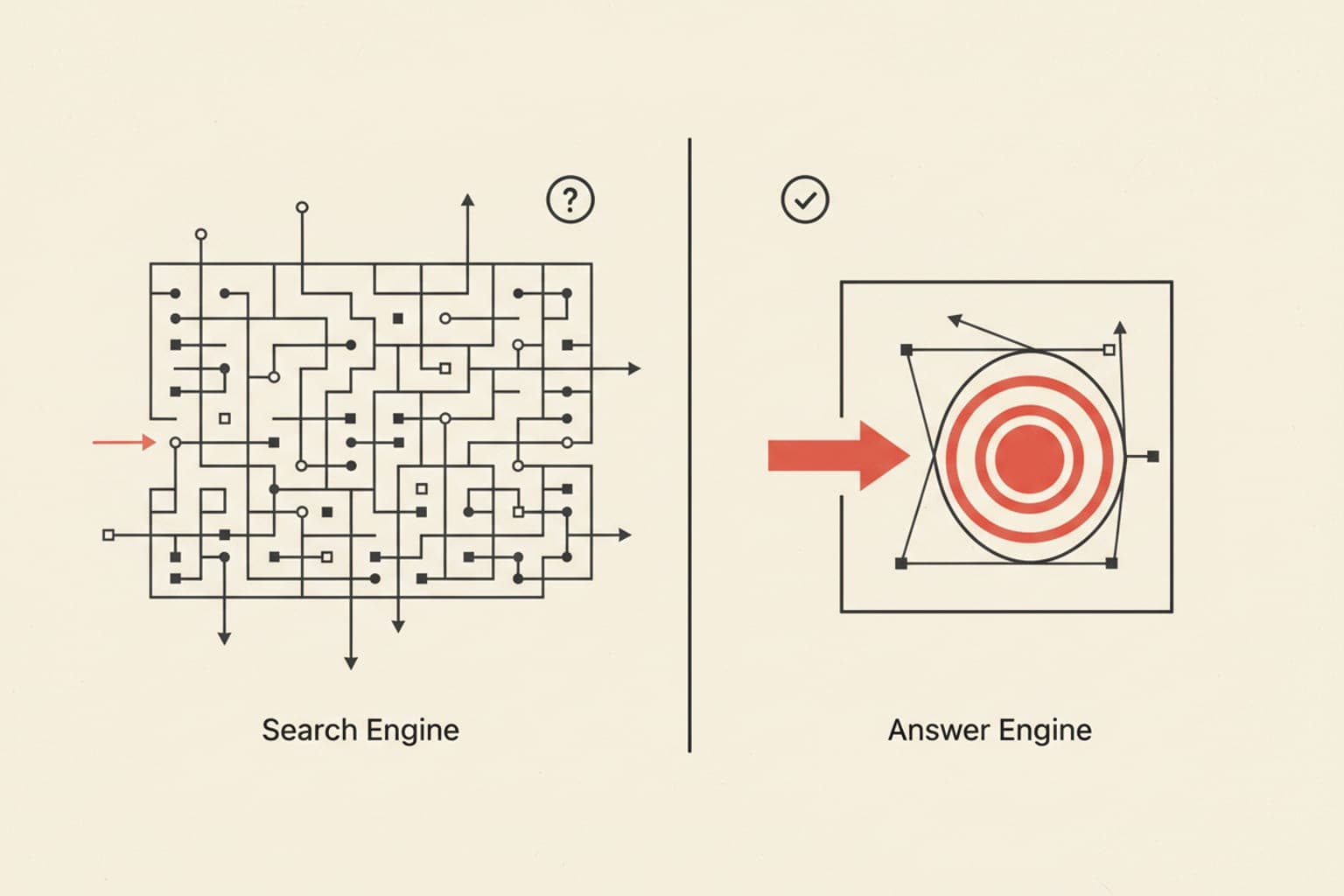
What Is Perplexity AI?#
Perplexity AI is an answer engine: a system that reads multiple web sources in real time, synthesizes the information, and delivers a single direct response with inline citations. Unlike Google, which returns a ranked list of links for users to click through, Perplexity attempts to resolve the user's query in full before surfacing sources.
This distinction is not cosmetic. It changes what it means to "rank" — being listed in Perplexity's citations is functionally equivalent to being recommended by the engine, not merely indexed by it.
How Does Perplexity AI Work?#
Perplexity combines a large language model (LLM) with real-time web retrieval. The workflow is roughly:
- Query interpretation — the LLM parses the user's intent.
- Live retrieval — the system fetches a set of current web pages relevant to that intent.
- Synthesis — the LLM reads the retrieved pages and generates a coherent answer.
- Citation attachment — sources are tagged inline so users can verify claims.
Because retrieval happens live, Perplexity can cite content published hours ago — a meaningful difference from static search indexes with crawl delays.
Search Engine vs Answer Engine: What Is the Difference?#
A search engine returns a ranked list of URLs. The user decides which link to click, reads the page, and forms their own answer. Ranking signals — backlinks, PageRank, Core Web Vitals — determine position.
An answer engine collapses that step. It reads the pages for the user and produces a synthesized answer. The signals that matter shift:
- Citability — does the page make a clear, quotable claim?
- Source authority — is the domain trusted by the model's retrieval layer?
- Structured clarity — are facts easy to extract in one or two sentences?
- Freshness — live retrieval rewards recently updated content.
This is why the emerging discipline of AEO (Answer Engine Optimization) exists alongside traditional SEO.
Why Does Perplexity AI Matter for SEO Professionals?#
Traffic from Perplexity arrives differently than Google traffic. A user who gets a complete answer may never visit your site — but your brand appears as a cited authority. That citation has real value: it builds topical trust and can drive high-intent follow-up visits.
For SEO professionals, the practical implication is that content architecture now needs to serve two audiences simultaneously: the human reader and the retrieval layer of an answer engine. If a page buries its key claim in paragraph eight, Perplexity may skip it entirely in favor of a page that leads with the answer.
What Content Signals Help Perplexity Cite Your Page?
- Direct-answer paragraphs immediately after question headings
- Short, declarative sentences that can be quoted without editing
- Accurate, up-to-date facts that don't conflict with consensus sources
- Clear authorship and entity signals that establish expertise
- Proper heading structure (H2/H3) that mirrors how users phrase questions
How Should You Optimize Content for Perplexity AI?#
Optimizing for Perplexity is largely about writing for human clarity — which reinforces traditional on-page SEO best practices rather than contradicting them.
- Front-load your key claim within the first 50 words of any article.
- Write question-format headings that match natural language queries.
- Keep paragraphs to three or four sentences maximum.
- Cite your own sources so the retrieval layer sees a chain of trust.
- Update cornerstone content regularly to stay within the freshness window.
Tools like SeoChatAI can audit whether your pages are structured in a way that answer engines can parse and cite — checking for issues like missing schema, weak heading hierarchy, and thin direct-answer coverage.
Is Perplexity AI a Threat to Google?#
Perplexity positions itself as a challenger to traditional search, but the two products serve overlapping rather than identical user needs. Users doing exploratory research — "explain X to me" — gravitate toward answer engines. Users with commercial or navigational intent — "buy X near me" or "log in to Y" — still rely on link-based search.
For content marketers, the realistic near-term picture is a multi-engine world where Google, Perplexity, ChatGPT Search, and similar tools each capture different query types. Optimizing for one without considering the others is increasingly a strategic gap.
How Do You Check If Your Site Is Ready for Answer Engines?#
An AEO readiness audit looks at several layers: technical structure (schema markup, semantic HTML), content quality (direct answers, citation-worthy claims), authority signals (E-E-A-T factors), and freshness. SeoChatAI runs this type of audit automatically, surfacing the specific gaps that reduce your chances of being cited by Perplexity and similar engines.
