Why FAQPage Schema Gets Cited 2–3× More by AI Engines
FAQPage schema wraps your Q&A content in machine-readable markup that AI engines parse directly into answers. Here's why it earns citations at a dramatically higher rate than unstructured content.
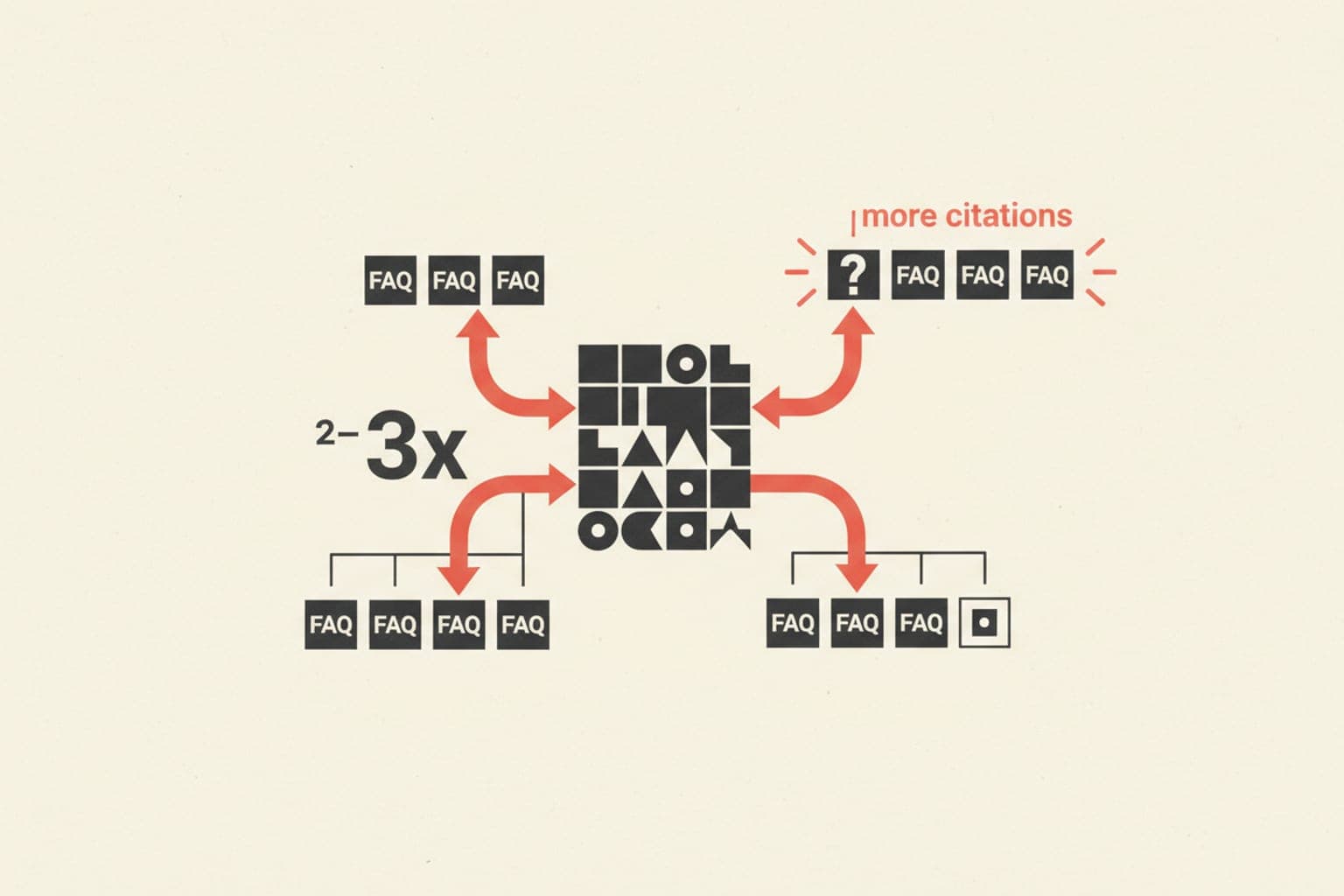
FAQPage schema consistently earns more citations from AI-powered search engines than unstructured prose. The reason is architectural: AI engines prefer content that is already segmented into discrete question-answer pairs, because that mirrors how they retrieve and surface answers.
What Is FAQPage Schema?#
FAQPage schema is a structured data type from Schema.org that wraps individual questions and their answers in machine-readable JSON-LD. Each Question entity contains an acceptedAnswer with a text property. Search engines and AI retrieval systems read this markup before rendering your page visually — making it one of the fastest signals an engine can parse.
{
  "@context": "https://schema.org",
  "@type": "FAQPage",
  "mainEntity": [
    {
      "@type": "Question",
      "name": "What is FAQPage schema?",
      "acceptedAnswer": {
        "@type": "Answer",
        "text": "FAQPage schema is structured data markup that labels Q&A content for search engines."
      }
    }
  ]
}
Why Do AI Engines Cite FAQPage Schema More Often?#
AI engines — including ChatGPT Search, Perplexity, and Google's AI Overviews — retrieve answers by matching a user query against chunks of content. FAQPage schema pre-chunks your content into exact question-answer units, which dramatically reduces the work the engine has to do. Unstructured paragraphs require the AI to infer where a question ends and an answer begins; schema removes that ambiguity entirely.
Three structural reasons explain the citation lift:
- Explicit intent signaling. The
Questionentity tells the engine this text is an answer to a specific query — not background context, not a transition sentence. - Bounded answer length. The
acceptedAnswer.textfield gives the engine a clean excerpt it can quote verbatim without truncation risk. - Semantic anchoring. Schema.org types are part of the knowledge graphs that AI engines use to cross-reference entities, reinforcing topical authority.
How Does FAQPage Schema Affect Google AI Overviews?#
Google's AI Overviews pull cited sources from pages where the answer confidence is high. Pages with FAQPage schema provide a structured confidence signal: the publisher has explicitly declared what the answer to a question is. This lowers the engine's uncertainty score for that Q&A pair and raises the probability it gets surfaced in an Overview.
Without schema, the same answer buried in a paragraph competes with every other sentence on the page for extraction priority.
What Makes a FAQPage Schema Entry Citation-Ready?#
Not all FAQ schema is equal. Entries that earn citations share four qualities:
- Question phrasing matches natural language queries. Use the exact phrasing a user would type, not marketing-speak.
- Answers are self-contained in 40–90 words. AI engines favor excerpts that stand alone without surrounding context.
- One answer per question. Combining two ideas in one answer dilutes the match signal.
- Answer text matches visible page content exactly. Discrepancies between schema and on-page text reduce trust scores.
You can validate and generate compliant markup quickly with the SeoChatAI Schema Generator.
How Many FAQ Entries Should a Page Include?#
Quality beats quantity. Three to eight tightly scoped Q&A pairs outperform twenty vague ones. Each entry should target a distinct sub-query — ideally variations from a single topic cluster rather than a broad sweep across unrelated subjects. Pages that cram in tangentially related questions dilute the topical coherence that AI engines use to assess authority.
Does FAQPage Schema Still Work After Google's Rich Result Changes?#
Google reduced FAQ rich results in standard organic SERPs in 2023, limiting them to authoritative government and health sites. However, this change affected visual rich results, not structured data parsing for AI Overviews or third-party AI engines. Perplexity, ChatGPT Search, and Bing Copilot all continue to parse FAQPage schema for answer extraction independently of Google's rich-result policies.
Implementing schema correctly remains one of the highest-ROI AEO tactics available, even if the yellow accordion in the SERP is no longer guaranteed.
How to Implement FAQPage Schema Correctly#
Follow these steps to deploy citation-ready FAQ schema:
- Identify the top 3–8 questions your target page already answers in its body copy.
- Write self-contained answers of 40–90 words each.
- Generate valid JSON-LD using a tool like the SeoChatAI Schema Generator to avoid syntax errors.
- Inject the JSON-LD block in the
<head>or just before</body>— both are valid per Google's spec. - Validate with Google's Rich Results Test and Schema.org's validator before publishing.
- Confirm on-page text matches schema text exactly.
What Common Mistakes Hurt FAQPage Schema Performance?#
The most damaging errors are:
- Keyword stuffing inside
acceptedAnswer.text. AI engines are trained to detect unnatural density; stuffed answers score lower for citation confidence. - Duplicate questions across multiple pages. This creates entity conflicts in the knowledge graph.
- Stale schema after page rewrites. If the visible answer changes but the schema does not update, engines detect the mismatch and deprioritize the source.
- Using FAQPage on pages that are not genuinely Q&A content. Misapplication is a trust signal in the wrong direction.
FAQPage schema is not a shortcut — it is an accurate representation of content that AI engines can act on. When the content genuinely answers the question and the markup faithfully reflects that answer, the citation lift is structural and durable.

Experimente o nosso JSON-LD schema generator gratuito
Ler artigo