DefinedTerm Schema: Why Glossaries Need It for AEO
DefinedTerm schema is structured markup that labels a term and its definition for AI search engines. Without it, your glossary is plain text — with it, it becomes a citable answer source.
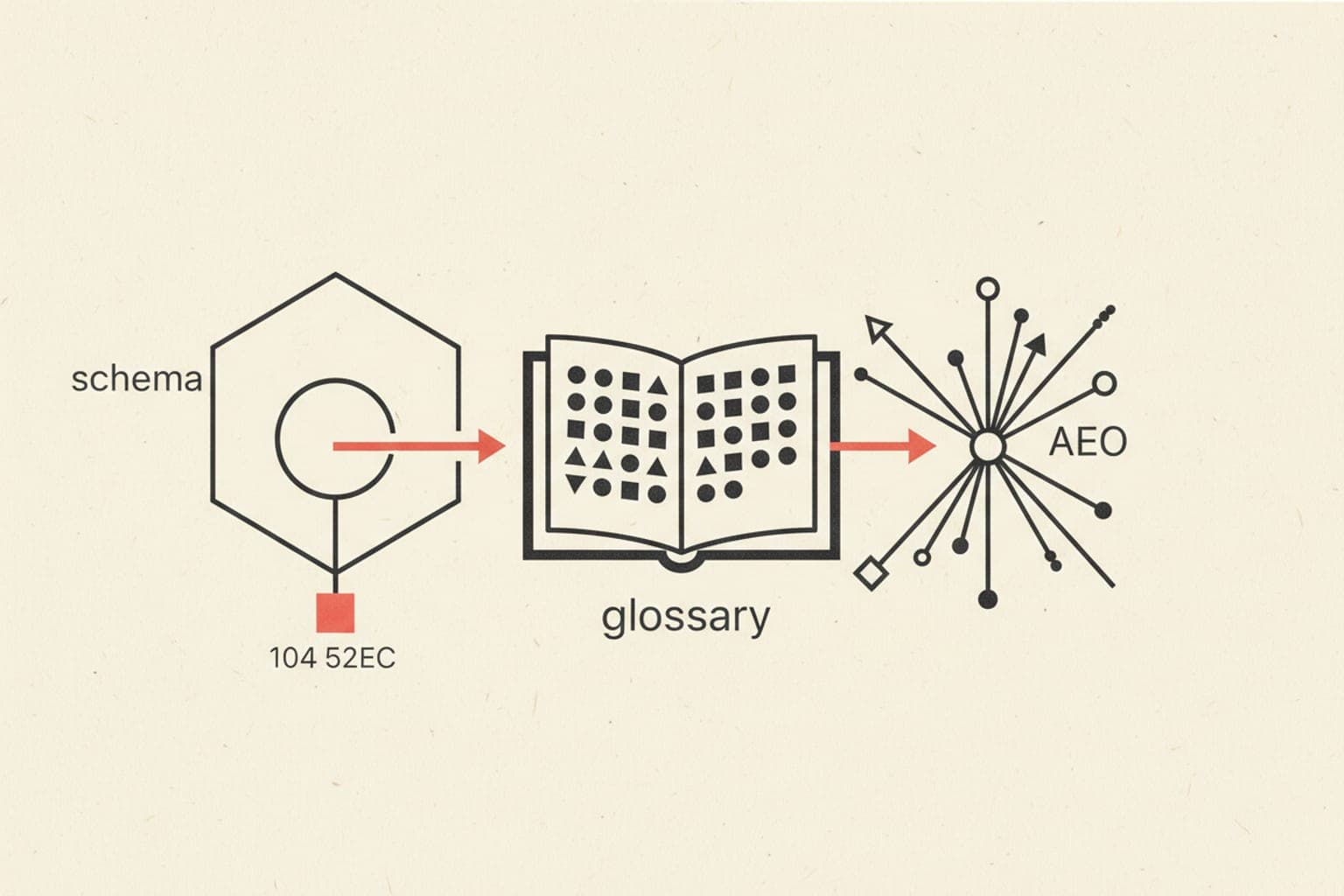
DefinedTerm schema is a Schema.org type that explicitly marks up a word or phrase alongside its definition, enabling AI search engines and answer engines to extract, cite, and surface your glossary content with precision. If you run a glossary and skip this markup, you are leaving AEO real estate on the table.
What Is DefinedTerm Schema?#
DefinedTerm (schema.org/DefinedTerm) is a structured data type used to identify a concept that has a formal, bounded definition within a specific context — usually a DefinedTermSet such as a glossary, taxonomy, or controlled vocabulary. It pairs a name (the term) with a description (the definition) and optionally links to the broader set it belongs to.
This is distinct from plain FAQ schema or Article schema. Those tell search engines that content exists. DefinedTerm tells them what a word means — a signal AI answer engines weight heavily when generating definitional responses.
How Does DefinedTerm Schema Work?#
At its core, the markup wraps each glossary entry with three key properties:
@type:DefinedTermname: the term being defined (e.g., "Canonical Tag")description: the concise, authoritative definitioninDefinedTermSet: a reference to the parent glossary (DefinedTermSet), which adds relational contexturl: the canonical URL of the term's own page or anchor
Search crawlers and LLM-based answer engines parse this markup to confirm that your page is not just mentioning a term but authoritatively defining it. That distinction drives citation selection in tools like Google's AI Overviews and Bing Copilot.
JSON-LD Implementation Example
{
  "@context": "https://schema.org",
  "@type": "DefinedTerm",
  "name": "Canonical Tag",
  "description": "An HTML link element that tells search engines which URL is the preferred version of a page, preventing duplicate content issues.",
  "url": "https://example.com/glossary#canonical-tag",
  "inDefinedTermSet": {
    "@type": "DefinedTermSet",
    "name": "SEO Glossary",
    "url": "https://example.com/glossary"
  }
}
Place this JSON-LD block in the <head> or inline <script> of each glossary entry page. If your glossary lives on a single paginated page, emit one block per term.
Why Does DefinedTerm Schema Matter for AEO?#
Answer Engine Optimization (AEO) is the practice of structuring content so AI-powered answer surfaces select it as a citation. AI search engines favor content that is:
- Unambiguous — the term and definition are explicitly paired, not inferred
- Contextually bounded — the definition lives within a known, labeled set
- Canonically attributed — a
urlsignals the authoritative source
Plain prose definitions satisfy none of these criteria structurally. DefinedTerm schema satisfies all three. When an AI engine encounters a user query like "what is a canonical tag," it prefers sources that have formally declared this is a definition over sources that merely include the word in a paragraph.
How Is DefinedTerm Different from FAQ Schema?#
FAQ schema (FAQPage) marks up question-and-answer pairs. The question can be anything — a how-to, an opinion, a comparison. DefinedTerm is semantically narrower: it signals a word has a meaning, not a question has an answer. For glossaries, DefinedTerm is the correct type. Using FAQ schema for definitions is a semantic mismatch that dilutes the signal.
What Is a DefinedTermSet?#
A DefinedTermSet is the parent container for a collection of DefinedTerms — your entire glossary. Declaring it gives AI engines relational context: these terms belong together, they share an authoring domain, and the set itself is a named resource. This relational layer strengthens topical authority signals across your entire vocabulary.
Add a single DefinedTermSet block on your glossary index page:
{
  "@context": "https://schema.org",
  "@type": "DefinedTermSet",
  "name": "SEO & AEO Glossary",
  "description": "Definitions of core terms in search engine optimization and answer engine optimization.",
  "url": "https://example.com/glossary"
}
How Do You Implement DefinedTerm Schema Efficiently?#
For small glossaries, hand-coding JSON-LD is practical. For glossaries with dozens or hundreds of terms, use a schema generation tool. The SeoChatAI Schema Generator outputs DefinedTerm and DefinedTermSet markup without requiring you to write JSON by hand — reducing syntax errors that silently invalidate your structured data.
Steps for a clean implementation:
- Audit your glossary: list every term and its current URL or anchor
- Write one precise definition per term (25–90 words works best for answer engine excerpts)
- Generate the JSON-LD for each term using a reliable tool
- Add the
DefinedTermSetblock to your glossary index - Validate each block via Google's Rich Results Test or Schema Markup Validator
- Monitor impressions and AI Overview appearances in Search Console
What Properties Should Every DefinedTerm Include?#
At minimum, include @type, name, description, and url. Additionally:
inDefinedTermSet: strongly recommended — ties the term to its authoritative collectionsameAs: optional URL to a Wikidata or Wikipedia entry for the concept, boosting entity disambiguationtermCode: used in formal taxonomies (e.g., medical or legal) — skip for general SEO glossaries
Omitting description is the most common mistake. Without it, the markup declares a term exists but does not supply the answer — defeating the entire AEO purpose.
Common Mistakes to Avoid#
- Nesting DefinedTerm inside Article schema without also emitting a standalone block — the relational signal gets lost
- Using
@type: Thinginstead ofDefinedTermfor glossary entries — too generic to trigger definitional features - Writing definitions over 200 words — answer engines excerpt short spans; long definitions dilute the extractable answer
- Skipping
url— without a canonical URL, the citation has no destination to surface
For teams managing large content operations, running your glossary pages through the SeoChatAI Schema Generator catches these issues before they reach production.
Key Takeaway#
DefinedTerm schema is not optional decoration for glossary pages — it is the structured signal that transforms a page of text into a machine-readable definition source. AI answer engines are trained to prefer explicit, bounded, attributed definitions. Implement DefinedTerm correctly and your glossary becomes infrastructure for AEO, not just reference content for human readers.

Essayez notre JSON-LD schema generator gratuit
Lire l'article