How to Rank in Google AI Overviews: Inherited-Rank Advantage
Google AI Overviews pull citations almost exclusively from pages already ranking in the top organic results. Earn the organic rank first — AIO visibility follows. Here's how to optimize for both.
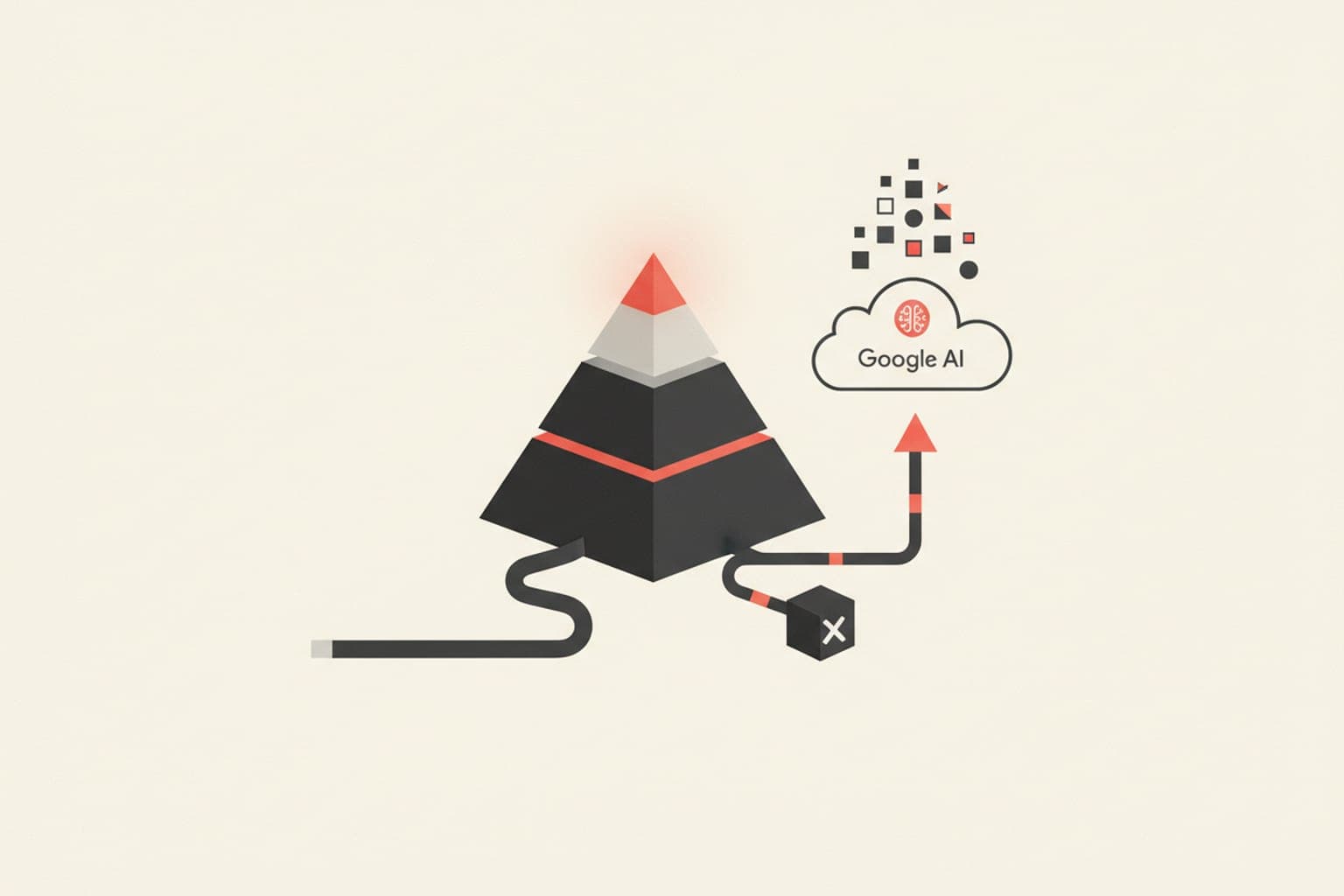
Google AI Overviews (AIO) do not run a separate crawl or maintain an independent index. The pages that appear as cited sources inside an AIO panel are drawn overwhelmingly from pages that already rank on page one of organic results for the same query. That single fact — the inherited-rank advantage — defines every practical tactic in this guide.
What Is the Inherited-Rank Advantage in Google AI Overviews?#
The inherited-rank advantage refers to the observed pattern in which Google's generative AI layer selects citation sources from its existing ranked results rather than discovering new content specifically for AIO. In practice, a page sitting in positions 1–10 for a given query has a dramatically higher probability of being cited inside the AIO box than a page sitting at position 20 or lower. You do not optimize for AIO independently — you optimize for organic ranking, and AIO eligibility is a downstream reward.
How Does Google Choose Which Pages to Cite in AI Overviews?#
Google's systems synthesize an answer and then surface supporting citations. The selection process favors pages that:
- Already rank highly for the trigger query or a close semantic variant
- Contain a direct, self-contained answer within the first 100–150 words
- Use clear heading structures that signal what question each section answers
- Demonstrate E-E-A-T signals (first-hand experience, authorship, citations to primary sources)
- Load quickly and are accessible to Googlebot (no soft-paywalls blocking crawl)
Pages that satisfy multiple signals simultaneously are selected most often. A technically sound page with weak topical authority rarely surfaces even if it ranks in position 3.
Why Organic Rank Is Still the Primary Lever#
Observational data from SEOs monitoring AIO panels consistently shows that cited URLs cluster in the top five organic positions. This is not coincidental — Google's generative layer is grounded in the same quality signals that determine ranking: PageRank, relevance, and content quality. Chasing AIO without first securing a strong organic position is a strategy with no foundation.
What this means practically
- Prioritize core ranking factors first. Backlinks, topical authority, and click-depth still move the needle more than any AIO-specific formatting trick.
- Treat position 1–5 as the threshold. Pages consistently sitting below position 6 rarely receive AIO citations for head or mid-tail queries.
- Monitor your AIO exposure by query segment. Branded and navigational queries almost never trigger AIO; informational and investigational queries do.
How to Structure Content for AIO Citation#
Once you have — or are within reach of — a top-five organic ranking, structure becomes the differentiator between being cited and being ignored.
Use direct-answer paragraphs immediately after headings
Google's extraction layer looks for a concise, standalone answer right below a heading. Write one paragraph of 40–80 words that answers the heading question completely, before expanding into detail. This mirrors how featured snippets work — because AIO and featured snippets share extraction infrastructure.
Match heading text to natural-language queries
Use H2 and H3 headings phrased as questions your audience actually searches: "What is X?", "How does Y work?", "Is Z safe?". Heading text that mirrors query syntax gives the extraction layer a clear anchor.
Keep paragraphs under four sentences
Long, dense paragraphs are harder for generative systems to extract cleanly. Four sentences maximum per paragraph. Use bullet lists for steps, comparisons, and feature sets — lists are extracted reliably.
Add a structured FAQ section
FAQ blocks — whether marked up with FAQPage schema or written as plain heading-answer pairs — cluster multiple extractable answers on a single URL. A page that answers five related questions has five entry points for AIO citation across five different queries.
What E-E-A-T Signals Matter Most for AIO?#
Experience, Expertise, Authoritativeness, and Trustworthiness are evaluated at the page, author, and site level. For AIO specifically, the signals that appear to matter most are:
- First-hand experience indicators — original data, case studies, or documented personal use
- Named authorship with a verifiable credential or author page
- Outbound citations to primary sources (research papers, official documentation, government data)
- Site-level trust — a clean security posture (HTTPS, no mixed content), a clear About/Contact structure, and a consistent publishing history
A page with strong E-E-A-T but mediocre ranking has a better shot at AIO citation than a thin page ranking at position 2. Both signals compound each other.
How to Audit Your Pages for AIO Readiness#
Run a structured audit against each candidate URL:
- Confirm organic position — Is the page in the top 5 for its primary query? Use Google Search Console Performance data.
- Check direct-answer density — Does each H2/H3 have a 40–80 word answer paragraph immediately below it?
- Review heading syntax — Are headings phrased as questions or clear topic declarations?
- Evaluate E-E-A-T signals — Is there a named author, outbound citations, and first-hand evidence?
- Test technical accessibility — Render the page in a JavaScript-disabled environment; if key content disappears, Googlebot may not see it.
- Check load speed — Core Web Vitals failures correlate with lower crawl priority, indirectly depressing AIO eligibility.
What Queries Trigger Google AI Overviews?#
Not every query generates an AIO panel. Triggers are most common for:
- How-to and process queries ("how to configure X", "steps to do Y")
- Definitional and explanatory queries ("what is X", "explain Y")
- Comparison queries ("X vs Y", "best tools for Z")
- Health, finance, and legal informational queries — though these are subject to additional quality filters
Transactional queries ("buy X", "X coupon") and branded navigational queries rarely trigger AIO. Focus your optimization effort on the informational and investigational segments of your keyword map.
Common Mistakes That Block AIO Appearance#
- Optimizing for AIO before securing organic rank. Fix the foundation first.
- Using JavaScript-rendered body text. If your main content is client-side rendered, Googlebot may miss it.
- Dense, unbroken prose. Structure content with headings, short paragraphs, and lists.
- No named authorship. Anonymous content is harder to attribute E-E-A-T signals to.
- Ignoring related queries. A page optimized for one head term may miss AIO for dozens of adjacent questions it could answer.
Summary: The AIO Optimization Stack#
Appearing in Google AI Overviews is not a separate discipline — it is the downstream result of executing organic SEO well. The stack, in priority order:
- Earn a top-5 organic ranking for your target queries
- Structure content with question-based headings and direct-answer paragraphs
- Demonstrate E-E-A-T through authorship, citations, and first-hand evidence
- Ensure technical accessibility and Core Web Vitals compliance
- Add a FAQ section to multiply per-page citation surface area
Every layer amplifies the layers below it. Start at the bottom and work up.
